THERE GO MY FIFTEEN MINUTES: First Thomas cuts my link out of Cool Cleveland, and now this.
This morning's "Blogosphere Cleveland" in the PD features a quote from this post but attributes it to our friends at Right Angle Blog. Must be some autonomic journalistic response to the name "Blackwell".
I feel so violated.
(Thanks for the heads-up, Tim.)
12.04.2005
STRICKLAND POSTED: The transcript and audio of the interview with Congressman Ted Strickland are finally on line at Meet The Bloggers.
12.01.2005
CONGRESSMAN STRICKLAND MEETS THE BLOGGERS: Six Cleveland bloggers (George, Tim, Adam, Jack, Gerardo and me) showed up at Talkie's today to quiz the candidate for governor about school finance, business taxes, small-scale economic development, trade policy, municipal home rule, the Third Frontier vs. the digital divide, and more.
The audio should be up this evening at www.meetthebloggers.net. And (drum roll, please) there'll be a transcript soon.
Meanwhile, George live-blogged it, and Adam's account is already posted at Now That's Progress.
(As a fringe benefit, I finally got to meet Jesse Taylor, who used to run Pandagon and gave it up to work for the Strickland campaign.)
The audio should be up this evening at www.meetthebloggers.net. And (drum roll, please) there'll be a transcript soon.
Meanwhile, George live-blogged it, and Adam's account is already posted at Now That's Progress.
(As a fringe benefit, I finally got to meet Jesse Taylor, who used to run Pandagon and gave it up to work for the Strickland campaign.)
11.30.2005
WKSU: "CLEVELAND DEFENDS PREDATORY LENDING LAW IN SUPREME COURT"
Here's the audio (mp3). This is an extremely important case on the municipal home rule front. Can a city go further to protect its citizens and neighborhoods from exploitative lenders than the industry's friends in the General Assembly want it to go? Stay tuned.
Here's the audio (mp3). This is an extremely important case on the municipal home rule front. Can a city go further to protect its citizens and neighborhoods from exploitative lenders than the industry's friends in the General Assembly want it to go? Stay tuned.
CONGRESSMAN STRICKLAND MEETS THE BLOGGERS TOMORROW: Rep.Ted Strickland, the Democratic frontrunner for Governor, Meets The Bloggers tomorrow. Any questions? (The commenters at Buckeye Politics have a few.)
A BUNCH OF NUMBERS ABOUT OUR ELECTRIC RATES
The Federal Energy Information Administration collects data every year from electric utilities, both public and private, on (among other things) their power sales and revenues. The complete annual databases back to 1990 are available for download. Last night I downloaded the files for 2004 and took a look.
Cleveland Public Power sold 410 million kilowatt-hours for home use last year for $43,854,000. That works out to 10.7 cents for their average residential kwh.
CEI/First Energy sold 1,587,912,000 residential kwh for $161,911,000, or 10.2 cents for the average kwh.
These average prices put Cleveland's two electric utilities right at the top of Ohio private and municipal electric providers. EIA's database shows eight other investor-owned electric utilities operating in Ohio, along with 43 other municipal power systems that serve more than 1,000 homes. Only one of them -- Toledo Edison, CEI's sister company -- had an average residential charge exceeding ten cents per kwh. The large majority were under nine cents, and more than half billed an average of less than eight cents.
CPP's average charge to commercial customers -- 10.55 cents -- was also the most expensive among significant Ohio private and municipal utilities, exceeded only by tiny Haskins Village (which seems to really stick it to the 39 businesses on its municipal system).
Like I've been saying, the most expensive electricity in Ohio comes from CPP.
But perhaps more troubling from an economic standpoint (i.e. our jobs rather than our budgets) is where our electric rates fit in the national picture. Here are the average kwh charges paid last year by commercial users in the twenty biggest Mid-Atlantic and Midwest cities, according to the EIA data:

Was someone talking about reducing the cost of doing business in Cleveland and Northeast Ohio? Maybe we could start with CPP and CEI rates. Just a thought.
The Federal Energy Information Administration collects data every year from electric utilities, both public and private, on (among other things) their power sales and revenues. The complete annual databases back to 1990 are available for download. Last night I downloaded the files for 2004 and took a look.
Cleveland Public Power sold 410 million kilowatt-hours for home use last year for $43,854,000. That works out to 10.7 cents for their average residential kwh.
CEI/First Energy sold 1,587,912,000 residential kwh for $161,911,000, or 10.2 cents for the average kwh.
These average prices put Cleveland's two electric utilities right at the top of Ohio private and municipal electric providers. EIA's database shows eight other investor-owned electric utilities operating in Ohio, along with 43 other municipal power systems that serve more than 1,000 homes. Only one of them -- Toledo Edison, CEI's sister company -- had an average residential charge exceeding ten cents per kwh. The large majority were under nine cents, and more than half billed an average of less than eight cents.
CPP's average charge to commercial customers -- 10.55 cents -- was also the most expensive among significant Ohio private and municipal utilities, exceeded only by tiny Haskins Village (which seems to really stick it to the 39 businesses on its municipal system).
Like I've been saying, the most expensive electricity in Ohio comes from CPP.
But perhaps more troubling from an economic standpoint (i.e. our jobs rather than our budgets) is where our electric rates fit in the national picture. Here are the average kwh charges paid last year by commercial users in the twenty biggest Mid-Atlantic and Midwest cities, according to the EIA data:

Was someone talking about reducing the cost of doing business in Cleveland and Northeast Ohio? Maybe we could start with CPP and CEI rates. Just a thought.
11.29.2005
DAVID ABBOTT MEETS THE BLOGGERS
The Executive Director of the George Gund Foundation answers questions from George, Tim, Pho and me about the Fund for Our Economic Future and its Voices And Choices program. It gets more argumentative than most of these interviews (and I ask one really, really longwinded question).
Update 12/1/05: Pho has some thoughts about the interview, as do the commenters at BFD.
The Executive Director of the George Gund Foundation answers questions from George, Tim, Pho and me about the Fund for Our Economic Future and its Voices And Choices program. It gets more argumentative than most of these interviews (and I ask one really, really longwinded question).
Update 12/1/05: Pho has some thoughts about the interview, as do the commenters at BFD.
ANOTHER NEW INDUSTRY WE WON"T GET IN NORTHEAST OHIO BECAUSE MIT'S RESEARCH IS ALWAYS AHEAD OF CASE
Will tinfoil protect your brain from the wi-fi freaks? Maybe not...
(Courtesy of wetmachine, which also has a roundup on municipal broadband politics around the country.)
Will tinfoil protect your brain from the wi-fi freaks? Maybe not...
(Courtesy of wetmachine, which also has a roundup on municipal broadband politics around the country.)
11.23.2005
DEMOCRATIC CAMPAIGN 2006: CHEAP SHOTS AND CRACKPOT PRAGMATISM?
Brewed Fresh Daily links to state senator Marc Dann's blog, which links to a Monday Plain Dealer story about the state's Third Frontier Internship program, in which "a spokesman for the Democratic party" says: "We're now using borrowed money to pay for these things, and I don't think people voted to use their bond money on internships. I think it's pretty outrageous."
Of course this is complete BS. No one is using bond money for any Third Frontier program, because no such money exists -- the ballot issue just passed two weeks ago and authorizing legislation has yet to be introduced. The current "Third Frontier Internship" program is supported by Federal Workforce Investment Act funds. Whether it's a good idea or not is, of course, open to debate, but this is the first time I've heard Democrats complaining about it. The internship program has been part of the Taft Third Frontier operation since 2003. I'm curious whether Senator Dann (or Mr. Rothenberg, the Party "spokesman") raised any objections to it before just about every Democrat in the General Assembly voted to put Issue 1 on the November ballot.
(It's too bad the PD didn't bother to check out the "payola/corporate welfare" angle with some of the Cleveland companies that are sponsoring 3F interns through Tri-C's Unified Technology Center, presumably with the enthusiastic blessings of Senators Prentiss, Brady and Fingerhut.)
As a partisan Democrat, this kind of lame cheap-shotting just drives me nuts -- especially when my party's "leadership" substitutes it for the hard work of coming up with better approaches to serious issues. Wasn't that John Glenn I saw fronting the Issue 1 commercials? If the Taft Third Frontier model is "corporate welfare", where's the Democrats' alternative program for driving high-tech job development? Do we have some better way than the 3F internships to get Ohio college students engaged with local tech companies? How would the Democrats do it better?
Of course Dann and Rothenberg don't want to talk about that -- all that matters is that there's a possible "pay to play" angle here (some internship money went to an organization connected to House Speaker Husted). Who cares about the actual merits of the program you're discrediting?
A few days ago, I spoke with a Democratic state representative who complained that the House Democratic leadership is actively discouraging its members from pushing alternative legislative proposals, in the belief that attempts to legislate will just get in the way of exploiting the corruption issue.
The correct term for this is "crackpot pragmatism"... and it's the best possible way for the Ohio Democratic Party to elect another Republican Governor -- probably one named Ken Blackwell.
Brewed Fresh Daily links to state senator Marc Dann's blog, which links to a Monday Plain Dealer story about the state's Third Frontier Internship program, in which "a spokesman for the Democratic party" says: "We're now using borrowed money to pay for these things, and I don't think people voted to use their bond money on internships. I think it's pretty outrageous."
Of course this is complete BS. No one is using bond money for any Third Frontier program, because no such money exists -- the ballot issue just passed two weeks ago and authorizing legislation has yet to be introduced. The current "Third Frontier Internship" program is supported by Federal Workforce Investment Act funds. Whether it's a good idea or not is, of course, open to debate, but this is the first time I've heard Democrats complaining about it. The internship program has been part of the Taft Third Frontier operation since 2003. I'm curious whether Senator Dann (or Mr. Rothenberg, the Party "spokesman") raised any objections to it before just about every Democrat in the General Assembly voted to put Issue 1 on the November ballot.
(It's too bad the PD didn't bother to check out the "payola/corporate welfare" angle with some of the Cleveland companies that are sponsoring 3F interns through Tri-C's Unified Technology Center, presumably with the enthusiastic blessings of Senators Prentiss, Brady and Fingerhut.)
As a partisan Democrat, this kind of lame cheap-shotting just drives me nuts -- especially when my party's "leadership" substitutes it for the hard work of coming up with better approaches to serious issues. Wasn't that John Glenn I saw fronting the Issue 1 commercials? If the Taft Third Frontier model is "corporate welfare", where's the Democrats' alternative program for driving high-tech job development? Do we have some better way than the 3F internships to get Ohio college students engaged with local tech companies? How would the Democrats do it better?
Of course Dann and Rothenberg don't want to talk about that -- all that matters is that there's a possible "pay to play" angle here (some internship money went to an organization connected to House Speaker Husted). Who cares about the actual merits of the program you're discrediting?
A few days ago, I spoke with a Democratic state representative who complained that the House Democratic leadership is actively discouraging its members from pushing alternative legislative proposals, in the belief that attempts to legislate will just get in the way of exploiting the corruption issue.
The correct term for this is "crackpot pragmatism"... and it's the best possible way for the Ohio Democratic Party to elect another Republican Governor -- probably one named Ken Blackwell.
11.22.2005
POCKETBOOK ISSUE SEEKING GOOD OWNER
Are you a newly elected (or re-elected) member of Cleveland City Council? Are you looking for a way to make your mark as a people's champion... stand out from the City Hall crowd... get noticed by voters in your own ward and across the city?
Baby, have I got an issue for you. Four words: Cleveland Public Power rates.
Average monthly cost of 750 kilowatt-hours,
November 2004 through October 2005
CEI (First Energy) -- $85.50
CEI with Cleveland's 5% aggregation discount -- about $81
Cleveland Public Power -- $85.33
Are you a newly elected (or re-elected) member of Cleveland City Council? Are you looking for a way to make your mark as a people's champion... stand out from the City Hall crowd... get noticed by voters in your own ward and across the city?
Baby, have I got an issue for you. Four words: Cleveland Public Power rates.
November 2004 through October 2005
CEI (First Energy) -- $85.50
CEI with Cleveland's 5% aggregation discount -- about $81
Cleveland Public Power -- $85.33
Yes, you're reading that right. For the last year Cleveland municipal electric households have been paying an average of 5% more for electric service than our neighbors who are served by CEI/First Energy -- who are, themselves, paying some of the highest private electric bills in Ohio.
For the ambitious City Council Member, this is an issue that has everything. It's about money out of tens of thousands of voters' pockets, every month. It's about broken promises (think of all those people who switched to CPP in the '90s because it was going to save them money!) It's your handle on Big Issues -- the household energy crisis, the cost of doing business in Cleveland, the plight of the poor.
Best of all, it's an issue you can actually do something about -- because CPP is a City agency, and City Council is its board of directors. That's you, my man (or woman).
This is a huge political opportunity, just sitting there waiting for someone like you. So go for it! Get yourself on Council's Public Utilities Committee. Do some homework. Make some noise. Become the voice of the angry ratepayer. Figure out a way to push those rates down.
That way, in four years, you can run as the Leader Who Lowered Our Electric Bills.
Otherwise... you can run as just another politician who failed to.
For the ambitious City Council Member, this is an issue that has everything. It's about money out of tens of thousands of voters' pockets, every month. It's about broken promises (think of all those people who switched to CPP in the '90s because it was going to save them money!) It's your handle on Big Issues -- the household energy crisis, the cost of doing business in Cleveland, the plight of the poor.
Best of all, it's an issue you can actually do something about -- because CPP is a City agency, and City Council is its board of directors. That's you, my man (or woman).
This is a huge political opportunity, just sitting there waiting for someone like you. So go for it! Get yourself on Council's Public Utilities Committee. Do some homework. Make some noise. Become the voice of the angry ratepayer. Figure out a way to push those rates down.
That way, in four years, you can run as the Leader Who Lowered Our Electric Bills.
Otherwise... you can run as just another politician who failed to.
11.20.2005
A LITTLE WAL-MART STORY: Sitting around the kitchen counter this morning with daughters. Oldest daughter says she's sorry she missed last weeks' showings of the new Wal-Mart movie. I say I didn't like it that much, and was frustrated by one particular thing -- the filmmaker has a number of former W-M workers on camera repeatedly but never once asks "How much were you paid?"
Oldest daughter then tells us about a woman she knows, the mother of a friend, who has worked at a Cleveland-area Wal-Mart for nearly seven years. This woman's current pay, after seven years on the job: Seven and a half dollars an hour.
Oldest daughter says the woman continues working for Wal-Mart mostly to get health insurance, which costs her a large part of her pay. After seven years the coverage is supposed to become vested. As she approaches her seventh anniversary, she has suddenly found herself under the microscope, and is pretty sure they're building a case to fire her before that magic day arrives.
Just thought I'd pass this along in case anyone is confused by that $10 average pay figure Wal-Mart likes to toss around.
(Oldest daughter also relates that she herself applied for a Wal-Mart job several years ago and was told she would start at minimum wage.)
Oldest daughter then tells us about a woman she knows, the mother of a friend, who has worked at a Cleveland-area Wal-Mart for nearly seven years. This woman's current pay, after seven years on the job: Seven and a half dollars an hour.
Oldest daughter says the woman continues working for Wal-Mart mostly to get health insurance, which costs her a large part of her pay. After seven years the coverage is supposed to become vested. As she approaches her seventh anniversary, she has suddenly found herself under the microscope, and is pretty sure they're building a case to fire her before that magic day arrives.
Just thought I'd pass this along in case anyone is confused by that $10 average pay figure Wal-Mart likes to toss around.
(Oldest daughter also relates that she herself applied for a Wal-Mart job several years ago and was told she would start at minimum wage.)
11.19.2005
WAL-MART SHOT DOWN BY VOTERS IN LORAIN, PULLING OUT IN VERMILION, RAIDED BY FEDS IN PHILADELPHIA
John Ryan has the stories here and here. But he points out that Wal-Mart "pulled out" of Steelyard Commons, too.
Speaking of Steelyard Commons, Tim Ferris mentioned to me the other day that there's a lot of heavy equipment on the site but most of it seems to be just sitting there. He's right... there's not much actual construction work going on, at least to the drive-by eye. I wonder why.
John Ryan has the stories here and here. But he points out that Wal-Mart "pulled out" of Steelyard Commons, too.
Speaking of Steelyard Commons, Tim Ferris mentioned to me the other day that there's a lot of heavy equipment on the site but most of it seems to be just sitting there. He's right... there's not much actual construction work going on, at least to the drive-by eye. I wonder why.
SMALL STEP: In response to Thursday's post, I got an email this morning from newly appointed Cleveland School Board member John Moss:
Actually, school board members are paid nothing.(Karen is John's wife.)
I agree, the more information the public has the better.
A small step, but you may post my e-mail: KarenMoss@adelphia.net.
11.18.2005
UNCOOL: On Tuesday Brewed Fresh Daily reported that a link to my "Voices and Choices vs. storm windows" post in a Cool Cleveland article had been scrubbed by CC honcho Thomas Mulready, along with a link to this from democracy guy. Thomas told George "he wasn’t going to promote people who sit on the sidelines and carp while others are doing economic development."
The BFD post drew a string of comments and led to more carping from Tim on his new blog... which I'm sure means more comments at BFD today. And there was this. Boy, you just can't buy this kind of exposure! If Thomas isn't getting advertising money from V&C he certainly should be.
So I've been sitting over here in the the UnCool Kids' Corner, pondering the meaning of it all. Did I get "censored"? Does this mean Cleveland Diary is too cool for Cool Cleveland to handle? Should I give a crap? Why would Thomas give a crap?
Here's the thing: I've never actually expressed an opinion about Voices and Choices here. All I wrote in the post that offended Thomas so much was that Pho's account of their Town Meeting was great, that I wasn't there because I decided it was too nice a day to spend indoors, and that it didn't sound like I'd missed much. Not what you'd call a ringing denunciation of V&C.
Okay, I called it "groupthink". Hey, there were nine hundred people there, thinking together. If that isn't a "group think", what is it?
And after the last two days' weather, is there really any doubt that my storm windows were a higher priority?
I admit that I didn't think much of V&C before, but I also didn't think much about it. If some foundations want to spend $3 million of their own money on a big expensive talkfest, what's it to me? They spend money on a lot of things, including some things I understand and support, and some I don't. Nothing new there.
But now I'm kind of compelled to take a personal interest in V&C. So I went back and read the Town Meeting "Participant Guide". And then I re-scanned the rest of the V&C website... and had a phone conversation with Josiette White of the V&C staff... and looked at the interview on WVIZ's Ideas last night (I missed Abbott and Whitehead but caught the two staffers.)
And now I have many questions about Voices and Choices.
That's for another post... but here's a tickler. The following appears in the Participant Guide as a statement of fact:
So... here we have Voices and Choices preparing its Town Hall participants for a discussion of "challenges" related to regional governance by giving them a dramatic -- indeed politically incendiary -- "fact" that's been lifted, uncredited, from another organization's material, which also offers it without a source and can't provide the source when asked.
Now where I come from, that's not cool.
More later.
The BFD post drew a string of comments and led to more carping from Tim on his new blog... which I'm sure means more comments at BFD today. And there was this. Boy, you just can't buy this kind of exposure! If Thomas isn't getting advertising money from V&C he certainly should be.
So I've been sitting over here in the the UnCool Kids' Corner, pondering the meaning of it all. Did I get "censored"? Does this mean Cleveland Diary is too cool for Cool Cleveland to handle? Should I give a crap? Why would Thomas give a crap?
Here's the thing: I've never actually expressed an opinion about Voices and Choices here. All I wrote in the post that offended Thomas so much was that Pho's account of their Town Meeting was great, that I wasn't there because I decided it was too nice a day to spend indoors, and that it didn't sound like I'd missed much. Not what you'd call a ringing denunciation of V&C.
Okay, I called it "groupthink". Hey, there were nine hundred people there, thinking together. If that isn't a "group think", what is it?
And after the last two days' weather, is there really any doubt that my storm windows were a higher priority?
I admit that I didn't think much of V&C before, but I also didn't think much about it. If some foundations want to spend $3 million of their own money on a big expensive talkfest, what's it to me? They spend money on a lot of things, including some things I understand and support, and some I don't. Nothing new there.
But now I'm kind of compelled to take a personal interest in V&C. So I went back and read the Town Meeting "Participant Guide". And then I re-scanned the rest of the V&C website... and had a phone conversation with Josiette White of the V&C staff... and looked at the interview on WVIZ's Ideas last night (I missed Abbott and Whitehead but caught the two staffers.)
And now I have many questions about Voices and Choices.
That's for another post... but here's a tickler. The following appears in the Participant Guide as a statement of fact:
The cost of government in Northeast Ohio, as a percent of Gross DomesticPretty explosive, yes? But where does this "fact" come from? No source is cited. I googled the whole unattributed passage and found the same exact words, also unsourced, in this brochure from the Northeast Ohio Sourcing Office. (Is this plagiarism? Steve Koff, call your office.) So I called NEOSO and asked its director, David Akers, for the source. Akers wasn't sure -- he knew he'd read it in some study, he thought he had it in his file, and he'd get back to me. (Very nice guy, incidentally.) I haven't heard anything yet.
Product (GDP), is more expensive than anywhere else in the country. Government
here costs taxpayers 21% of GDP. Nationwide the cost is 17% of GDP.
So... here we have Voices and Choices preparing its Town Hall participants for a discussion of "challenges" related to regional governance by giving them a dramatic -- indeed politically incendiary -- "fact" that's been lifted, uncredited, from another organization's material, which also offers it without a source and can't provide the source when asked.
Now where I come from, that's not cool.
More later.
11.17.2005
GOOD MOVE, FRANK: Mayor-elect Jackson does the smart thing... and does it promptly. An excellent sign.
Now let's see if the School Board members who wanted to keep the job can start doing it. It would be helpful for Jackson to lay out publicly what he expects from them in the next two years. It would also be helpful if the Board members started acting like a real, open, accountable public body. One small step: Tell the staff to post the District's most recent audited financials and the minutes of each Board meeting on the District's website. Another small step: A public email address for each Board member.
Incidentally, School Board members are paid almost nothing. This is probably a mistake, but it's what we've got, and I'm sure it makes it very difficult for them to commit the time that the job really requires. An open discussion of this problem wouldn't hurt.
Now let's see if the School Board members who wanted to keep the job can start doing it. It would be helpful for Jackson to lay out publicly what he expects from them in the next two years. It would also be helpful if the Board members started acting like a real, open, accountable public body. One small step: Tell the staff to post the District's most recent audited financials and the minutes of each Board meeting on the District's website. Another small step: A public email address for each Board member.
Incidentally, School Board members are paid almost nothing. This is probably a mistake, but it's what we've got, and I'm sure it makes it very difficult for them to commit the time that the job really requires. An open discussion of this problem wouldn't hurt.
11.14.2005
A DAY WITHOUT GROUPTHINK: Pho has a terrific post about the Voices and Choices "town meeting" in Akron on Saturday.
I registered for this shindig Friday evening and started out for Akron Saturday morning, but somewhere around Brecksville I realized it was way too nice a day to spend groupthinking in Rhodes Auditorium. So I turned around, went home and put up a couple of new storm windows. My voice, my choice.
Doesn't sound like I missed much.
I registered for this shindig Friday evening and started out for Akron Saturday morning, but somewhere around Brecksville I realized it was way too nice a day to spend groupthinking in Rhodes Auditorium. So I turned around, went home and put up a couple of new storm windows. My voice, my choice.
Doesn't sound like I missed much.
11.13.2005
JACKSON AND THE SCHOOL BOARD: As he promised during the campaign, Frank Jackson is expected to ask School Board members to resign and let him decide whether to re-appoint them. It looks like some are not in a mood to cooperate. John Ryan and Marybeth Matthews think they should.
Nothing would please me more than a new School Board, but I've got misgivings about Jackson's position on two levels.
First, there's the problem of respect for the law. Jackson, as Mary Ann Sharkey acknowledges in the PD article, has no legal basis for his demand. The Board members (including the "big Campbell supporter" who got his appointment the day after Jane Campbell lost the election) are duly constituted public officials who do not serve at the Mayor's pleasure. They aren't an advisory committee to the Mayor. They're the city's legal board of education, with all the powers and responsibilities that entails.
The Mayor has only two formal powers in this mislabeled "mayoral control" system: The power to veto the Board's choice of a CEO (which means he will control this key decision assuming it isn't made before January) and the power to appoint new Board members when seats open up. Five of the nine members' terms will end in 2007, so that's when Mayor Jackson gets to install his own majority. Until then, Campbell's appointees remain in charge. That's not an accident, it's exactly what the law -- which Clevelanders voted to keep on the books just three years ago -- intends.
Those looming 2007 appointments, plus the immediate CEO hiring process -- plus just being Mayor -- give Jackson lots of leverage over broad school policy for the next two years. He doesn't need to demand immediate, extralegal authority; he probably won't get it anyway; and by trying he'll guarantee a terrible relationship with the (totally legitimate) Board majority. What's the up side of having this fight now?
My second misgiving is about Jackson's stated political basis for the fight, the "standards" that Jackson says he wants to apply to his appointments: "active involvement in the schools, have attended public schools and have children who attend or attended Cleveland schools... people who have a stake in the system."
Really? Only former CMSD students with kids who've gone to CMSD schools should serve on the School Board? Does Jackson really mean to say these are the School Board's only true constituents, the only Clevelanders who really "... have a stake in the system"?
Wow. So much for all the other residents and taxpayers. So much for all those people who've ponied up private school tuition over the last twenty-five years so they could stay in the city without putting their kids at risk. So much for people who've directly experienced schools that really work -- schools, for example, that actually get lots of their graduates into colleges other than Tri-C. So much for learning the lessons of last August, when a strategy aimed at excluding "non-public-school voters" from the levy vote led to a disastrous backlash. So much for Candidate Jackson's house-meeting promise that his education strategy would unite the interests of both public and private school families.
Apparently we're about to revert to the self-destructive notion, practiced by Byrd-Bennett and her compliant Board, that the only community that matters is the "school community" of CMSD parents, staff, volunteers, and supporters. Only we're taking it a step further, and insisting on a Board composed entirely of the parents.
For Mayor-elect Jackson, this is exactly the wrong message, and he needs to stop sending it right now. The CMSD is not a club, to be run by and for its user-members. It's a public institution, a tax-supported government agency, owned by the whole public of the city. The School Board must start representing that whole public... and so must Jackson, in appointing them. Trying to throw serving members off the Board early because they aren't part of the schools' current customer base... well, I don't think that's ground that the new Mayor really wants to be standing on.
Update: You know what? Seven of the current nine Board members are either Cleveland public school graduates, and/or parents of Cleveland public school students or grads. It's right there in their bios on the CMSD website. The exceptions are Vice Chair Grady Burrows and new member John Moss (not yet profiled on the site). So... what's the issue again?
Nothing would please me more than a new School Board, but I've got misgivings about Jackson's position on two levels.
First, there's the problem of respect for the law. Jackson, as Mary Ann Sharkey acknowledges in the PD article, has no legal basis for his demand. The Board members (including the "big Campbell supporter" who got his appointment the day after Jane Campbell lost the election) are duly constituted public officials who do not serve at the Mayor's pleasure. They aren't an advisory committee to the Mayor. They're the city's legal board of education, with all the powers and responsibilities that entails.
The Mayor has only two formal powers in this mislabeled "mayoral control" system: The power to veto the Board's choice of a CEO (which means he will control this key decision assuming it isn't made before January) and the power to appoint new Board members when seats open up. Five of the nine members' terms will end in 2007, so that's when Mayor Jackson gets to install his own majority. Until then, Campbell's appointees remain in charge. That's not an accident, it's exactly what the law -- which Clevelanders voted to keep on the books just three years ago -- intends.
Those looming 2007 appointments, plus the immediate CEO hiring process -- plus just being Mayor -- give Jackson lots of leverage over broad school policy for the next two years. He doesn't need to demand immediate, extralegal authority; he probably won't get it anyway; and by trying he'll guarantee a terrible relationship with the (totally legitimate) Board majority. What's the up side of having this fight now?
My second misgiving is about Jackson's stated political basis for the fight, the "standards" that Jackson says he wants to apply to his appointments: "active involvement in the schools, have attended public schools and have children who attend or attended Cleveland schools... people who have a stake in the system."
Really? Only former CMSD students with kids who've gone to CMSD schools should serve on the School Board? Does Jackson really mean to say these are the School Board's only true constituents, the only Clevelanders who really "... have a stake in the system"?
Wow. So much for all the other residents and taxpayers. So much for all those people who've ponied up private school tuition over the last twenty-five years so they could stay in the city without putting their kids at risk. So much for people who've directly experienced schools that really work -- schools, for example, that actually get lots of their graduates into colleges other than Tri-C. So much for learning the lessons of last August, when a strategy aimed at excluding "non-public-school voters" from the levy vote led to a disastrous backlash. So much for Candidate Jackson's house-meeting promise that his education strategy would unite the interests of both public and private school families.
Apparently we're about to revert to the self-destructive notion, practiced by Byrd-Bennett and her compliant Board, that the only community that matters is the "school community" of CMSD parents, staff, volunteers, and supporters. Only we're taking it a step further, and insisting on a Board composed entirely of the parents.
For Mayor-elect Jackson, this is exactly the wrong message, and he needs to stop sending it right now. The CMSD is not a club, to be run by and for its user-members. It's a public institution, a tax-supported government agency, owned by the whole public of the city. The School Board must start representing that whole public... and so must Jackson, in appointing them. Trying to throw serving members off the Board early because they aren't part of the schools' current customer base... well, I don't think that's ground that the new Mayor really wants to be standing on.
Update: You know what? Seven of the current nine Board members are either Cleveland public school graduates, and/or parents of Cleveland public school students or grads. It's right there in their bios on the CMSD website. The exceptions are Vice Chair Grady Burrows and new member John Moss (not yet profiled on the site). So... what's the issue again?
11.11.2005
PUCO SAYS "FORGET IT", CHAS SAYS "YES"
With this little election on my mind, I never got around to reporting the PUCO's decision on the SBC/AT&T merger case and the consumer proposals discussed here last Thursday. Long story short, on Friday morning the PUCO gave its blessing to the companies' joint operations in Ohio and declined to impose any of the conditions requested by consumer intervenors, except to require SBC (which will now be called AT&T) to offer "stand-alone" DSL service. Bummer. But not necessarily the last word on the subject since, as you may have heard, there's an election for Governor coming up... and the Governor appoints the PUCO.
If you're a true rootin-tootin policy geek, here's the download link for the actual decision (a looong pdf file). For extra points, see how long it takes you to find where they quote me.
The good news is that Chas Rich of NEO babble has agreed to my proposal for a Meet The Bloggers debate on the subject. I've promised to buy the coffee, but he apparently expects me to also "hand him his lunch" or something. Maybe we'll just split a sandwich. Details to follow.
With this little election on my mind, I never got around to reporting the PUCO's decision on the SBC/AT&T merger case and the consumer proposals discussed here last Thursday. Long story short, on Friday morning the PUCO gave its blessing to the companies' joint operations in Ohio and declined to impose any of the conditions requested by consumer intervenors, except to require SBC (which will now be called AT&T) to offer "stand-alone" DSL service. Bummer. But not necessarily the last word on the subject since, as you may have heard, there's an election for Governor coming up... and the Governor appoints the PUCO.
If you're a true rootin-tootin policy geek, here's the download link for the actual decision (a looong pdf file). For extra points, see how long it takes you to find where they quote me.
The good news is that Chas Rich of NEO babble has agreed to my proposal for a Meet The Bloggers debate on the subject. I've promised to buy the coffee, but he apparently expects me to also "hand him his lunch" or something. Maybe we'll just split a sandwich. Details to follow.
ABE LINCOLN, PLAGIARIST
Here's Cleveland Uber Alles on the Sherrod Brown "plagiarism scandal".
What he said.
Here's Cleveland Uber Alles on the Sherrod Brown "plagiarism scandal".
What he said.
11.09.2005
CROSSING THE RIVER: About 97,000 Clevelanders voted in the mayoral election yesterday... not terrible, though about 12,000 short of the total in 2001 and 70,000 fewer than made it to the polls for Kerry/Bush in 2004.
Frank Jackson's 55% was almost exactly what the WKYC and Plain Dealer polls were showing last week, before Campbell's ballyhooed "You don't know me" TV ad. She seems to have picked up most of the late undecided voters, but that was nowhere near enough to make the race close. Jackson was sitting on solid, overwhelming support in Wards 1 through 10 and showed significant strength in Collinwood and the "white" West Side wards as well -- he broke 40% in Wards 13, 14 and 19 and got 35-40% in 17, 18 and 20. As the polls suggested, this election was over weeks ago, if not months.
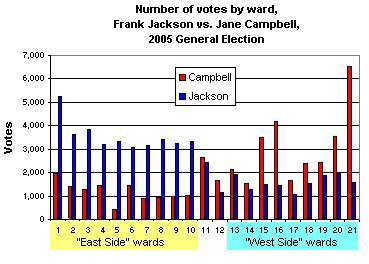
So Jackson has a rare chance to solidify a base on both sides of the river and both sides of the city's racial divide. But he's not going to accomplish this through leadership deals, task forces, summit meetings, or grand top-down schemes. He can accomplish it by going back out to his voters on both sides of town, listening to them seriously, dealing with them forthrightly and honestly, and offering them effective connections to City Hall and to each other.
Jackson is making history as the first person in over a century to go straight from Council to the Mayor's Office. But he can make some real history and turn his "one city" rhetoric into reality, by being a Mayor who keeps practicing the skills of a good Councilman -- a leader who empowers, networks and supports other leaders of all kinds, in all parts of the community.
Wouldn't that be a refreshing change?
Frank Jackson's 55% was almost exactly what the WKYC and Plain Dealer polls were showing last week, before Campbell's ballyhooed "You don't know me" TV ad. She seems to have picked up most of the late undecided voters, but that was nowhere near enough to make the race close. Jackson was sitting on solid, overwhelming support in Wards 1 through 10 and showed significant strength in Collinwood and the "white" West Side wards as well -- he broke 40% in Wards 13, 14 and 19 and got 35-40% in 17, 18 and 20. As the polls suggested, this election was over weeks ago, if not months.

So Jackson has a rare chance to solidify a base on both sides of the river and both sides of the city's racial divide. But he's not going to accomplish this through leadership deals, task forces, summit meetings, or grand top-down schemes. He can accomplish it by going back out to his voters on both sides of town, listening to them seriously, dealing with them forthrightly and honestly, and offering them effective connections to City Hall and to each other.
Jackson is making history as the first person in over a century to go straight from Council to the Mayor's Office. But he can make some real history and turn his "one city" rhetoric into reality, by being a Mayor who keeps practicing the skills of a good Councilman -- a leader who empowers, networks and supports other leaders of all kinds, in all parts of the community.
Wouldn't that be a refreshing change?
11.08.2005
TURNOUT NOT ABYSMAL, BUT PRETTY BAD: In the October primary, 132 ballots were cast at my precinct, 15F in Brooklyn Centre.
When I voted at 3 today I was ballot number 120. The election judges said the morning was slow but things picked up in the afternoon. At least 75 or 80 more people should vote in that precinct during the evening rush, maybe even 100. So today's vote in 15F looks on track to beat the primary by 55%-65%... a normal increase, but pretty low compared to the 272 votes we cast in 2001.
Projected citywide, that would mean 85,000-95,000 total votes, compared to 110,000 in the 2001 race. But remember, we've got a hot Council race pulling up turnout in Ward 15. My best guess, not that it matters at all: 80,000 to 85,000.
When I voted at 3 today I was ballot number 120. The election judges said the morning was slow but things picked up in the afternoon. At least 75 or 80 more people should vote in that precinct during the evening rush, maybe even 100. So today's vote in 15F looks on track to beat the primary by 55%-65%... a normal increase, but pretty low compared to the 272 votes we cast in 2001.
Projected citywide, that would mean 85,000-95,000 total votes, compared to 110,000 in the 2001 race. But remember, we've got a hot Council race pulling up turnout in Ward 15. My best guess, not that it matters at all: 80,000 to 85,000.
WITH FRIENDS LIKE THESE: So developer Mitch Schneider has blown another few thousand bucks on a last-minute full-page Plain Dealer ad, pleading with Cleveland voters to re-elect Jane Campbell because Steelyard Commons will be so wonderful for the city. (There's no link available but it was on yesterday's page B-5, on the other side of the obituary page.)
The ad rehashes the same old stories: 1,800 jobs, taxes galore, Wal-Mart shopping right in your neighborhood. Ron Copfer competently dissected these arguments at BFD. If you're new to this debate, and not sure what to think, I'll self-servingly refer you here and here.
But what strikes me about the ad is Schneider's apparent desperate need to believe that his project can still, somehow, be a big electoral asset to the Mayor -- long after the Campbell campaign itself has stopped talking much about it.
Mr. Schneider, here's the truth: As much as any one person, you cost Jane Campbell this election. You helped hammer the last nail into the coffin of her relationship with several City Council members who are now helping to deliver West Side votes to Jackson. You cost her unified labor support, which as a previously endorsed incumbent was still hers to lose before "Wal-Mart Commons" put it out of reach. You saddled her with one more front-page round of backroom deals, broken promises and controversial associations ("the Wal-Mart mayor") just when it could do her uphill re-election effort the most damage.
All that political damage to the Mayor could have been avoided if the Steelyard Commons project had been pursued more openly, more modestly, more patiently, with a genuine willingness to bend to legitimate community interests. But you dissembled about the project's true nature early, attacked and demeaned its doubters, maneuvered and dodged to avoid any compromise, and ultimately got the Mayor to align herself with the absolute worst nightmare of a lot of people who were once among her best friends.
For this, she got some campaign money, a chance to cut your ribbon, and some job projections that nobody believes. And now... a full-page ad that will make no difference at all.
Nice job, Schneider. With friends like you...
The ad rehashes the same old stories: 1,800 jobs, taxes galore, Wal-Mart shopping right in your neighborhood. Ron Copfer competently dissected these arguments at BFD. If you're new to this debate, and not sure what to think, I'll self-servingly refer you here and here.
But what strikes me about the ad is Schneider's apparent desperate need to believe that his project can still, somehow, be a big electoral asset to the Mayor -- long after the Campbell campaign itself has stopped talking much about it.
Mr. Schneider, here's the truth: As much as any one person, you cost Jane Campbell this election. You helped hammer the last nail into the coffin of her relationship with several City Council members who are now helping to deliver West Side votes to Jackson. You cost her unified labor support, which as a previously endorsed incumbent was still hers to lose before "Wal-Mart Commons" put it out of reach. You saddled her with one more front-page round of backroom deals, broken promises and controversial associations ("the Wal-Mart mayor") just when it could do her uphill re-election effort the most damage.
All that political damage to the Mayor could have been avoided if the Steelyard Commons project had been pursued more openly, more modestly, more patiently, with a genuine willingness to bend to legitimate community interests. But you dissembled about the project's true nature early, attacked and demeaned its doubters, maneuvered and dodged to avoid any compromise, and ultimately got the Mayor to align herself with the absolute worst nightmare of a lot of people who were once among her best friends.
For this, she got some campaign money, a chance to cut your ribbon, and some job projections that nobody believes. And now... a full-page ad that will make no difference at all.
Nice job, Schneider. With friends like you...
"CLEVELAND'S NEW MULTI-RACIAL MAYOR": Mandatory reading at democracy guy.
Jackson personifies the truth that "race" is a political and social construct, not a biological one. If you take a kid whose dad is African-American and whose mom is Italian-American, plop him down in Cleveland and let American life take its course, what do you get? A "black candidate" for mayor.
We may well be watching the exit of the last "white" mayor of Cleveland. Can the "white" minority of the city get our collective head around this demographic fact? Judging from the poll results -- with over a third of "white" voters and nearly 40% of "West Side" voters choosing Jackson in the Channel 3 poll last week -- we're making some progress, Mike Dolan and his ilk notwithstanding.
Sixteen years ago Mike White was elected mayor by West Side voters who preferred him to George Forbes. For a brief moment, as an East Side politician with an energized West Side base, White had the chance to remake the conscious racial-political geography of the city. For whatever reason, he made no serious effort to do so, and the moment passed.
Having taken a very different path, Frank Jackson is about to arrive at that same moment of opportunity. The difference is, he will have gotten there far more deliberately... and he appears to be a far better man for the task.
Jackson personifies the truth that "race" is a political and social construct, not a biological one. If you take a kid whose dad is African-American and whose mom is Italian-American, plop him down in Cleveland and let American life take its course, what do you get? A "black candidate" for mayor.
We may well be watching the exit of the last "white" mayor of Cleveland. Can the "white" minority of the city get our collective head around this demographic fact? Judging from the poll results -- with over a third of "white" voters and nearly 40% of "West Side" voters choosing Jackson in the Channel 3 poll last week -- we're making some progress, Mike Dolan and his ilk notwithstanding.
Sixteen years ago Mike White was elected mayor by West Side voters who preferred him to George Forbes. For a brief moment, as an East Side politician with an energized West Side base, White had the chance to remake the conscious racial-political geography of the city. For whatever reason, he made no serious effort to do so, and the moment passed.
Having taken a very different path, Frank Jackson is about to arrive at that same moment of opportunity. The difference is, he will have gotten there far more deliberately... and he appears to be a far better man for the task.
11.05.2005
DOLAN MAILING CONDEMNS JACKSON FOR PREDATORY LENDING LAW THAT DOLAN VOTED FOR (AND CAMPBELL SUPPORTED)
The infamous "Be true 2 da game" postcard from Ward 21 Councilman "Wal-Mart Mike" Dolan showed up in my Ward 15 mailbox today, so I guess it must be part of the Campbell campaign's general West Side end game. (Unless, of course, the Mayor disowns it... but I haven't gotten that email yet. I wonder what the Red Room Revolutionaries think?)
My favorite line on the postcard is this item in the list of Frank Jackson's "game-playing":
21-0. Why, that means Mike Dolan must have voted for it! He must feel terrible, now that "many Financial Institutions have stopped mortage lending in Cleveland" because of his vote. I wonder if he's going to publicly apologize to the residents of Ward 21.
What a weasel.
The infamous "Be true 2 da game" postcard from Ward 21 Councilman "Wal-Mart Mike" Dolan showed up in my Ward 15 mailbox today, so I guess it must be part of the Campbell campaign's general West Side end game. (Unless, of course, the Mayor disowns it... but I haven't gotten that email yet. I wonder what the Red Room Revolutionaries think?)
My favorite line on the postcard is this item in the list of Frank Jackson's "game-playing":
Sponsored legislation that caused many Financial Institutions to stop mortgage lending in Cleveland.We're a little light on footnotes here, but the only Jackson-sponsored ordinance dealing with mortgages that I know of is the 2003 predatory lending ordinance. You know, the one the Campbell Administration proudly supported and has been defending in court against state pre-emption. The one that passed City Council on January 13, 2003 by a vote of 21 to 0. (Here's the relevant City Record... see pages 6 to 9.)
21-0. Why, that means Mike Dolan must have voted for it! He must feel terrible, now that "many Financial Institutions have stopped mortage lending in Cleveland" because of his vote. I wonder if he's going to publicly apologize to the residents of Ward 21.
What a weasel.
11.04.2005
ANOTHER REASON TO BELIEVE IN CLEVELAND
Stephen Colbert profiles the 11th Congressional District and discusses recipes with Congresswoman TJ.
Stephen Colbert profiles the 11th Congressional District and discusses recipes with Congresswoman TJ.
Cleveland is where the term "rock and roll" was born. It's also the home of the Rock and Roll Hall of Fame, where rock and roll goes to die.
"MILKING THE CASH COW": If you pay property taxes and/or vote in Cleveland, I strongly, strongly recommend this on-the-scene report from MaryBeth Matthews on how that big school renovation project -- you know, the one we voted a special levy for -- is going. Be sure to read the comments.
DEMOCRACY REDUCTION UPDATE: Peter Kirsanow of the Ohio Citizens' League got back to me yesterday and arranged to have a pdf of the League's City Council reduction petition emailed to me today. (Thank you, Mr. Kirsanow and Ms. Battaglia.)
It turns out that the samizdat copy I quoted Wednesday was not the final version, though the content is identical. I've posted the PDF version of the real thing here (Acrobat Reader required). Here are the key parts:
Another, possibly unintended consequence would be to sever the elections for Council and Mayor. Council election years would now be 2007, 2011, 2015, etc. while the Mayoral race would still be in 2009, 2013, 2017, etc. Gotta think about he consequences of that.
It turns out that the samizdat copy I quoted Wednesday was not the final version, though the content is identical. I've posted the PDF version of the real thing here (Acrobat Reader required). Here are the key parts:
The Council, not later than ten (10) days after the certification of the [initiative] election results by the Board of Elections... shall redivide the City into seven (7) wards...Everything I said about this proposal on Wednesday stands, with one exception: It looks like the proposed Charter change, if passed in 2006, would require new Council elections in November 2007 (Cleveland's next "regular municipal election") rather than 2009. So the twenty-one Council Members elected next Tuesday would have only two years to serve their current wards, before being thrown into a bloody free-for-all for the seven new, much bigger ward seats or the four citywide seats. (Like I said, good luck getting your Councilman to return a call during those two years... he or she will be much too busy talking to campaign funders.)
The Council of the City shall consist of eleven (11) members, four (4) of which shall be elected at-large and the remaining seven (7) of which shall be elected by ward.
The eleven (11) Councilmen to be elected under the terms herein shall be elected at the next regular Municipal Election in accordance with the provisions of Chapter 3 of the Charter of the City of Cleveland. The division of the City into wards existing at the time of the adoption of this amendment shall continue until changed as provided.
Another, possibly unintended consequence would be to sever the elections for Council and Mayor. Council election years would now be 2007, 2011, 2015, etc. while the Mayoral race would still be in 2009, 2013, 2017, etc. Gotta think about he consequences of that.
WHEN YOU SAY "ALTRUISM" TO ME, BUDDY, YOU BETTER SMILE: Chas Rich at NEO babble gets into some heavy snark about the Cronin/Stuber op-ed I linked in my last post. Chas thinks Kevin and Angela are insufficiently "altruistic" (i.e. just trying to get money for their programs) and that there's no reason to expect SBC to provide broadband service in less dense, poorer parts of their market. He apparently likes the idea of getting SBC to butt out of municipal broadband investments, though.
Well, I helped draft the proposals he doesn't like as well as the one he does, and I make no claim of "altruism" in the matter. I damn well do want more support for Digital Vision's member computer centers as well as community networking efforts like Tremont WiFi. I think SBC should help provide it if they want to keep their privileged position in Ohio's telecom market while merging with one of their major competitors.
And yes, I think broadband Internet access is now a necessity for many households and a basic telecom service for all. If SBC wants to be a privileged "incumbent provider" and buy out competitors at the same time, they should at least be required to get that basic service rolled out to all their customers in affordable configurations... which, at this point, they haven't.
So Chas, you want to step outside and settle this? I propose a debate on the subject. In fact, I propose making it a Meet The Bloggers event (sorry, George and Tim, but if we can't get Jackson and Campbell in the same ring why not me and Chas?)
Come on, Chas, you and me. I'll buy the first two rounds of coffee.
Well, I helped draft the proposals he doesn't like as well as the one he does, and I make no claim of "altruism" in the matter. I damn well do want more support for Digital Vision's member computer centers as well as community networking efforts like Tremont WiFi. I think SBC should help provide it if they want to keep their privileged position in Ohio's telecom market while merging with one of their major competitors.
And yes, I think broadband Internet access is now a necessity for many households and a basic telecom service for all. If SBC wants to be a privileged "incumbent provider" and buy out competitors at the same time, they should at least be required to get that basic service rolled out to all their customers in affordable configurations... which, at this point, they haven't.
So Chas, you want to step outside and settle this? I propose a debate on the subject. In fact, I propose making it a Meet The Bloggers event (sorry, George and Tim, but if we can't get Jackson and Campbell in the same ring why not me and Chas?)
Come on, Chas, you and me. I'll buy the first two rounds of coffee.
11.03.2005
PUCO DECISION IS IMMINENT ON SBC/AT&T MERGER: The Public Utilities Commission of Ohio is scheduled to rule tomorrow on the request by SBC and AT&T to approve their operation as a merged telecom provider in Ohio.
Ohio is one of two states where PUCs are still pursuing real investigations before applying the rubber stamp. The other is California, where the regulators issued a "proposed decision" two weeks ago approving the merger, but attaching some conditions proposed by consumer and community technology advocates.
A similar list of conditions is on the table in Ohio, put forward by a coalition that includes the Ohio Consumers' Counsel, community groups from Dayton and the Appalachian region, and two Cleveland groups represented by Joe Meissner of Legal Aid -- the Neighborhood Environmental Council and the Coalition for Fair Utility Rates. They're basically about broadband affordability and access for residents of Ohio's central cities as well as rural areas. (I had a hand in putting the list together as board president of the Ohio Community Computing Network, which consulted and provided testimony for some of the community intervenors.)
A few of the proposed conditions:
Will the PUCO include any of this in its ruling tomorrow? It's not outside the realm of possibility. Their meeting starts at 10 am tomorrow, and I'm told it's viewable by real-time webcast -- check here to see if that's true. And stay tuned.
P.S. To see the Ohio consumer parties' entire proposal, download the whole brief here (it's a pdf file). The proposed conditions start on page 49.
Ohio is one of two states where PUCs are still pursuing real investigations before applying the rubber stamp. The other is California, where the regulators issued a "proposed decision" two weeks ago approving the merger, but attaching some conditions proposed by consumer and community technology advocates.
A similar list of conditions is on the table in Ohio, put forward by a coalition that includes the Ohio Consumers' Counsel, community groups from Dayton and the Appalachian region, and two Cleveland groups represented by Joe Meissner of Legal Aid -- the Neighborhood Environmental Council and the Coalition for Fair Utility Rates. They're basically about broadband affordability and access for residents of Ohio's central cities as well as rural areas. (I had a hand in putting the list together as board president of the Ohio Community Computing Network, which consulted and provided testimony for some of the community intervenors.)
A few of the proposed conditions:
No more efforts by the merged company to restrict investments in broadband networks by local governmentsKevin Cronin, a longtime community tech advocate here, and Angela Stuber of OCCN submitted an op-ed about all this to the Plain Dealer the week before last. It hasn't appeared in print, but strangely enough it's been posted since Monday in the PD's "other columns" section at cleveland.com.
Universal availability of DSL internet service for residents throughout the SBC service territory, within three years
A combined Lifeline rate of no more than $25 for basic telephone and broadband service for low-income homes
Funding support for community technology centers in low-income areas, as well as nonprofit community networking efforts
Will the PUCO include any of this in its ruling tomorrow? It's not outside the realm of possibility. Their meeting starts at 10 am tomorrow, and I'm told it's viewable by real-time webcast -- check here to see if that's true. And stay tuned.
P.S. To see the Ohio consumer parties' entire proposal, download the whole brief here (it's a pdf file). The proposed conditions start on page 49.
11.02.2005
DEMOCRACY REDUCTION: Well, I still haven't heard back from Mr. Kirsanow or anyone else from the Ohio Citizens' League, so I haven't seen an actual copy of their petition, but someone just gave me a copy of a fax of the language. Assuming it's the real thing, here's the key change it would make to the Cleveland City Charter:
I think it's fair to call that a two-thirds reduction in the democracy available to Cleveland citizens.
The seven new wards would have to be drawn right away, even though the current 21 wards would remain in place until the next election in 2009. So any Council Member who wanted to win one of those seven redrawn seats, let alone one of the four at-large, would have to spend his or her entire term raising money and getting known to voters outside his or her own ward. Good luck getting your Councilman on the phone for the next four years!
Of course, potential campaign bankrollers like Tony George, Michael Gibbons, and Peter Kirsanow's partners at Benesch, Friedlander -- not to mention Sam Miller, Dave Daberko, Dan Moore, Mal Mixon, Ed Crawford, etc. etc. -- would have no such problem.
Which is the whole, you know, point.
So... will this monstrosity make it onto the ballot? Probably yes. A charter amendment petition only requires signatures equivalent to 10% of the votes cast in the last regular municipal election. That'll be the one coming up, in which the turnout could easily be less than 70,000. So 7,000 to 8,000 valid signatures are probably all the Ohio Citizens' League needs to force a vote -- maybe in the Spring 2006 primary, maybe earlier.
Can it pass? Trying to cut direct Council representation by two-thirds seems like a pretty big stretch, maybe an overreach. But maybe Kirsanow and company don't care. Maybe the idea is just to keep all the Democrats in Cleveland busy and distracted next year, when the GOP wants us to focus as little as possible on the statewide election. You have to admit that would be pretty clever.
Funny thing is, there's a regular, mandatory twenty-year review of the whole City Charter coming up in 2008, a year before the next Council election. It's laid out in Chapter 39 of the Charter, right after the description of the Charter amendment initiative process. You'd think the Citizens' League folks would have noticed it when they were researching their petition. You'd think they might have said: "Oh, look... here's a process for raising our concerns about the size of City Council in an open, orderly way. Let's start educating and organizing people to participate in the Charter Review."
But for some reason, they didn't. Maybe they just didn't notice that next paragraph. Who can say?
You could ask them if they show up outside your polling place with the Democracy Reduction Petition next Tuesday.
The Legislative power of the City, except as reserved to the people by this Charter, shall be vested in a Council, consisting of four (4) members elected at large and seven (7) members of which shall be elected from separate wards.So, if this thing passes, the population of a Cleveland Council ward jumps from around 22,000 (the size of Solon or Brookpark) to more than 60,000 (bigger than Lakewood).
I think it's fair to call that a two-thirds reduction in the democracy available to Cleveland citizens.
The seven new wards would have to be drawn right away, even though the current 21 wards would remain in place until the next election in 2009. So any Council Member who wanted to win one of those seven redrawn seats, let alone one of the four at-large, would have to spend his or her entire term raising money and getting known to voters outside his or her own ward. Good luck getting your Councilman on the phone for the next four years!
Of course, potential campaign bankrollers like Tony George, Michael Gibbons, and Peter Kirsanow's partners at Benesch, Friedlander -- not to mention Sam Miller, Dave Daberko, Dan Moore, Mal Mixon, Ed Crawford, etc. etc. -- would have no such problem.
Which is the whole, you know, point.
So... will this monstrosity make it onto the ballot? Probably yes. A charter amendment petition only requires signatures equivalent to 10% of the votes cast in the last regular municipal election. That'll be the one coming up, in which the turnout could easily be less than 70,000. So 7,000 to 8,000 valid signatures are probably all the Ohio Citizens' League needs to force a vote -- maybe in the Spring 2006 primary, maybe earlier.
Can it pass? Trying to cut direct Council representation by two-thirds seems like a pretty big stretch, maybe an overreach. But maybe Kirsanow and company don't care. Maybe the idea is just to keep all the Democrats in Cleveland busy and distracted next year, when the GOP wants us to focus as little as possible on the statewide election. You have to admit that would be pretty clever.
Funny thing is, there's a regular, mandatory twenty-year review of the whole City Charter coming up in 2008, a year before the next Council election. It's laid out in Chapter 39 of the Charter, right after the description of the Charter amendment initiative process. You'd think the Citizens' League folks would have noticed it when they were researching their petition. You'd think they might have said: "Oh, look... here's a process for raising our concerns about the size of City Council in an open, orderly way. Let's start educating and organizing people to participate in the Charter Review."
But for some reason, they didn't. Maybe they just didn't notice that next paragraph. Who can say?
You could ask them if they show up outside your polling place with the Democracy Reduction Petition next Tuesday.
11.01.2005
REBECCA RYAN MEETS THE BLOGGERS (AND SHE'S NOT EVEN RUNNING FOR MAYOR)
"THE Gen-Xpert" who is "moving the American workplace to its next threshold of success" (it says so right here on her business card) comes off in this MTB conversation as a nice, intelligent, level-headed young entrepreneur/researcher who's just trying to share her data.
Well, okay... but what's all this on the website about how "her brilliance in presenting [trends] to professionals at all levels, makes her one of America's most captivating communicators and futurists"?
Can you say "cognitive dissonance"?
In case you missed it, Ryan raised some dust in Akron recently by taking a six-digit fee to produce a report for the Chamber of Commerce on how to make the city more attractive to "Gen-Xers". Her eighteen top recommendations are here. Her harshest Akron blogcritic is here.
"THE Gen-Xpert" who is "moving the American workplace to its next threshold of success" (it says so right here on her business card) comes off in this MTB conversation as a nice, intelligent, level-headed young entrepreneur/researcher who's just trying to share her data.
Well, okay... but what's all this on the website about how "her brilliance in presenting [trends] to professionals at all levels, makes her one of America's most captivating communicators and futurists"?
Can you say "cognitive dissonance"?
In case you missed it, Ryan raised some dust in Akron recently by taking a six-digit fee to produce a report for the Chamber of Commerce on how to make the city more attractive to "Gen-Xers". Her eighteen top recommendations are here. Her harshest Akron blogcritic is here.
MESSAGE TO PETER KIRSANOW: I sent this last Thursday evening to the Benesch, Friedlander email address of Peter Kirsanow, spokesman for the Ohio Citizens' League petition drive to reduce Cleveland City Council:
Dear Mr. Kirsanow,No response so far. Three business days and counting.
I am writing to you as the spokesman for the Ohio Citizens' League in the
recent WEWS story about the League's petition campaign to change the size of
Cleveland City Council.
I have been unable to find a phone number, address or website for the Ohio
Citizens' League, but I gather you are one of its leaders. Could you please tell
me how I can obtain a copy of the League's Council reduction petition?
Thank you.
10.31.2005
STRICKLAND TO MEET THE BLOGGERS: Congressman Ted Strickland, one of the leading candidates for the Democratic nomination for Governor, has committed to Meet The Bloggers on December 1. What do you want us to ask?
More at BFD.
More at BFD.
FORTY WORDS OR LESS: Here are the four questions the Plain Dealer thought were most important to ask Cleveland City Council candidates for a special "Election 2005" section yesterday (never mind that they actually printed the wrong questions):
Memo to the editors of the Plain Dealer: In forty words or less, please explain exactly how you decided that the largely theoretical issue of "regional services" should take priority over the following questions for Council candidates:
Mayor Jane Campbell recently launched a "zero-blight initiative" to deal with vacant housing in Cleveland. Do you feel the plan is adequate? If not, what steps would you take to deal with vacant homes?Forty words or less? The fourth question itself is forty-nine words long. How the hell would anyone give a meaningful answer to any of these questions in forty words?
In 40 words or less, please explain what more Cleveland can do to lure businesses and jobs.
In 40 words or less, cite specific actions you would take to reduce drug dealing and nuisance crimes such as vandalism, loud music and loitering, in city neighborhoods.
Many suburbs in Greater Cleveland are debating forms of regionalism, such as merging fire services, sharing equipment, sharing recreation facilities, creating a countywide recreation district, to reduce the cost of services. Should Cleveland be a part of these discussions? In 40 words or less, please explain why or why not.
Memo to the editors of the Plain Dealer: In forty words or less, please explain exactly how you decided that the largely theoretical issue of "regional services" should take priority over the following questions for Council candidates:
As a member of City Council you would effectively control hundreds of thousands of dollars in annual "ward allocations" of CDBG and infrastructure funds. What process would you use to determine the uses of this money each year?Remember, your answer will be edited if it exceeds forty words. Thanks for your prompt response.
Do you think there should be fewer City Council members? How would you react to the current Ohio Citizens' League petition to cut the number of ward council seats in half?
Please explain the proper relationship between a City Council member and the community development corporation, if any, working in your ward.
As a Council member, would you support a new convention center plan that required the imposition of taxes on your constituents? Under what circumstances?
Next Summer, Council will be asked to approve a cable TV franchise renewal and transfer from Adelphia to Time-Warner. Do you have any concerns or proposals to bring to this process? What are your goals, if any, for telecommunications and information technology development in your ward?
Do you agree with the idea of city-imposed limits or living wage requirements on big box grocery stores being built in the city? If not, what would you do, if anything, to promote the survival of neighborhood grocery stores?
What are your plans to help the residents of your ward deal with energy costs, if any? Specifically discuss the role of the city-owned electric utility.
What are your specific plans, if any, to improve the education and income prospects of the poorest 25% of your ward's residents?
10.27.2005
A SEINFELD ELECTION: Kudos to Chas Rich for his point-by-point blogging of last night's mayoral debate... if "debate" is the right word. Do these two disagree about anything except what they think of each other?
This is coming off as the Seinfeld Show of elections -- an election about nothing. An election about relationship issues.
What would Frank Jackson try to do as mayor that Jane Campbell is against? What would Campbell try to do in a second term that Jackson opposes? I don't mean like who'll get a contract, who'll get a job, whose program will gain or lose funding, who'll get the mayor's ear. These questions matter intensely to lots of insiders on either side... but don't matter at all to most potential voters, whose political self-interests revolve around safety, neighborhood services, economic opportunity, their kids, their utility and tax bills. What important differences are there between the two candidates' records and promises on these basic concerns?
If this "debate" was any guide, the answer is -- no important differences at all.
Which was undoubtedly the main cause of the record low primary turnout, as well as the record low general election turnout that everyone seems to expect (present company included). If you can't tell the candidates apart, why vote?
This is coming off as the Seinfeld Show of elections -- an election about nothing. An election about relationship issues.
What would Frank Jackson try to do as mayor that Jane Campbell is against? What would Campbell try to do in a second term that Jackson opposes? I don't mean like who'll get a contract, who'll get a job, whose program will gain or lose funding, who'll get the mayor's ear. These questions matter intensely to lots of insiders on either side... but don't matter at all to most potential voters, whose political self-interests revolve around safety, neighborhood services, economic opportunity, their kids, their utility and tax bills. What important differences are there between the two candidates' records and promises on these basic concerns?
If this "debate" was any guide, the answer is -- no important differences at all.
Which was undoubtedly the main cause of the record low primary turnout, as well as the record low general election turnout that everyone seems to expect (present company included). If you can't tell the candidates apart, why vote?
WHO'S THE "OHIO CITIZENS' LEAGUE"? On Tuesday Channel 5 ran a story about the newest petition to reduce the size of Cleveland City Council. The sponsoring group is something called the "Ohio Citizens' League", represented in the WEWS piece by a guy named Pete Kirsanow.
There's no such organization in the Cleveland phone book. Google finds nothing for "Ohio Citizens' League" but rehashes of the WEWS story and another, shorter one from Channel 3. But a search of the Secretary of State's nonprofit corporation database yields the following:
The Ohio Citizen's League was incorporated less than six months ago, in May 2005, though the name was reserved in 2004. Its three incorporators were Thomas T. George, 18605 Detroit Avenue, Lakewood; Michael E. Gibbons, 1111 Superior Avenue, Suite 900, Cleveland; and Peter N. Kirsanow, 2300 BP Tower, 200 Public Square, Cleveland.
Gibbons is Senior Managing Director and Chairman of Brown Gibbons Lang & Company, a major Republican donor, and a resident of Fairview Park.
"Thomas T. George" is Tony George, the millionaire Lakewood restaurant owner and political player (18605 Detroit is the address of his Harry Buffalo bar), who apparently lives in Westlake.
Kirsanow is a partner at Benesch Friedlander, a controversial Bush appointee to the U.S. Civil Rights Commission, and a national activist and spokesman for Republicanism in the black community. Unlike the other two incorporators, Mr. Kirsanow lives in Cleveland, which probably explains why he's the public face of the petition campaign.
These are the guys leading the charge for less direct, face-to-face representation of Cleveland citizens at City Hall. Kind of makes you think, doesn't it?
(John Ryan blogged his suspicions on Tuesday.)
There's no such organization in the Cleveland phone book. Google finds nothing for "Ohio Citizens' League" but rehashes of the WEWS story and another, shorter one from Channel 3. But a search of the Secretary of State's nonprofit corporation database yields the following:
The Ohio Citizen's League was incorporated less than six months ago, in May 2005, though the name was reserved in 2004. Its three incorporators were Thomas T. George, 18605 Detroit Avenue, Lakewood; Michael E. Gibbons, 1111 Superior Avenue, Suite 900, Cleveland; and Peter N. Kirsanow, 2300 BP Tower, 200 Public Square, Cleveland.
Gibbons is Senior Managing Director and Chairman of Brown Gibbons Lang & Company, a major Republican donor, and a resident of Fairview Park.
"Thomas T. George" is Tony George, the millionaire Lakewood restaurant owner and political player (18605 Detroit is the address of his Harry Buffalo bar), who apparently lives in Westlake.
Kirsanow is a partner at Benesch Friedlander, a controversial Bush appointee to the U.S. Civil Rights Commission, and a national activist and spokesman for Republicanism in the black community. Unlike the other two incorporators, Mr. Kirsanow lives in Cleveland, which probably explains why he's the public face of the petition campaign.
These are the guys leading the charge for less direct, face-to-face representation of Cleveland citizens at City Hall. Kind of makes you think, doesn't it?
(John Ryan blogged his suspicions on Tuesday.)
10.26.2005
POLICY MATTERS REPORT: 22,000 POTENTIAL OHIO JOBS IN RENEWABLE ENERGY
I missed it but Hypothetically Speaking didn't. Policy Matters released a study Tuesday detailing potential Ohio job creation under the national renewable energy investment plan advocated by the Apollo Alliance. More than 5,000 of those jobs could be in Cuyahoga, Lorain and Summit Counties.
The premise of these calculations is a $72 billion national investment in "50,000 megawatts of wind energy, 9,260 megawatts of photovoltaic or solar energy, 8,700 megawatts of biomass energy, and 6,077 megawatts of geothermal energy". Of course, this premise is, well, hypothetical. But the Policy Matters/Apollo study shows in detail how specific Ohio industries and counties would benefit from turning that hypothetical into a reality.
Given the unending brutal impact of high natural gas and electric bills on Cleveland consumers, and the massive flow of energy dollars out of the Northeast Ohio economy, it's remarkable that energy efficiency and local sourcing still rank so low on Cleveland's economic agenda. (For example, neither of the two candidates for Mayor is saying anything at all about these issues.) Maybe the Policy Matters report will help break the silence.
I missed it but Hypothetically Speaking didn't. Policy Matters released a study Tuesday detailing potential Ohio job creation under the national renewable energy investment plan advocated by the Apollo Alliance. More than 5,000 of those jobs could be in Cuyahoga, Lorain and Summit Counties.
The premise of these calculations is a $72 billion national investment in "50,000 megawatts of wind energy, 9,260 megawatts of photovoltaic or solar energy, 8,700 megawatts of biomass energy, and 6,077 megawatts of geothermal energy". Of course, this premise is, well, hypothetical. But the Policy Matters/Apollo study shows in detail how specific Ohio industries and counties would benefit from turning that hypothetical into a reality.
Given the unending brutal impact of high natural gas and electric bills on Cleveland consumers, and the massive flow of energy dollars out of the Northeast Ohio economy, it's remarkable that energy efficiency and local sourcing still rank so low on Cleveland's economic agenda. (For example, neither of the two candidates for Mayor is saying anything at all about these issues.) Maybe the Policy Matters report will help break the silence.
10.25.2005
"In the prevailing myth, Parks decides to act almost on a whim, in isolation. She's a virgin to politics, a holy innocent. The lesson seems to be that if any of us suddenly got the urge to do something equally heroic, that would be great. Of course most of us don't, so we wait our entire lives to find the ideal moment.
"Parks's real story conveys a far more empowering moral. She begins with seemingly modest steps. She goes to a meeting, and then another. Hesitant at first, she gains confidence as she speaks out. She keeps on despite a profoundly uncertain context, as she and others act as best they can to challenge deeply entrenched injustices, with little certainty of results. Had she and others given up after her tenth or eleventh year of commitment, we might never have heard of Montgomery.
"Parks's journey suggests that change is the product of deliberate, incremental action, whereby we join together to try to shape a better world. Sometimes our struggles will fail, as did many earlier efforts of Parks, her peers, and her predecessors. Other times they may bear modest fruits. And at times they will trigger a miraculous outpouring of courage and heart -- as happened with her arrest and all that followed. For only when we act despite all our uncertainties and doubts do we have the chance to shape history."Paul Loeb, "The Real Rosa Parks"
CAMPBELL CAMPAIGN E-MAIL: CHANNEL 3 POLL SHOWS JACKSON AHEAD BY 20 POINTS
The following just arrived in a "Campbell for Cleveland" email:
Update: The WKYC poll story is now posted here. The full results are here. It's easy to see why the Campbell campaign reacted so defensively. If these numbers are even approximately accurate, the Mayor is fried.
If Jerry Austin has a poll that looks "dead even" and wants to argue methodology, he'd better release the whole thing right now.
The following just arrived in a "Campbell for Cleveland" email:
This evening Channel 3 will broadcast the results of their recent poll...Actually, SurveyUSA's polling for Channel 3 was extremely accurate in the primary.
The results they will broadcast are fallacious. Jackson 54 - Campbell
34 and here's why.
The demographics which should be 50/50 east and west and 50/50 black
and white are:
61% east
54 % black
15% seniors
60 % under 49.
The senior number is ridiculous. Seniors and over 50 year olds are the
largest voting blocks.
Our internal poll completed last week showed the race dead even.
Update: The WKYC poll story is now posted here. The full results are here. It's easy to see why the Campbell campaign reacted so defensively. If these numbers are even approximately accurate, the Mayor is fried.
If Jerry Austin has a poll that looks "dead even" and wants to argue methodology, he'd better release the whole thing right now.
10.24.2005
HEY BRENT, IS THIS EAST 110TH OR WEST 110TH?
The Plain Dealer's ponderous editorial endorsements in Cleveland Council races might carry a little more weight if they could just get the ward numbers right.
Kevin Conwell represents Ward 9.
The Plain Dealer's ponderous editorial endorsements in Cleveland Council races might carry a little more weight if they could just get the ward numbers right.
Kevin Conwell represents Ward 9.
10.23.2005
BRAIN DRAIN OR BRAIN BOTTLENECK?
For the last few weeks I've had the pleasure of working with a group, led by County Treasurer Jim Rokakis, that's looking into a possible county college loan initiative. Recently we asked NODIS, the local census gurus at Cleveland State, to run some crosstabulations on county residents' college enrollment by household income. Here's what we got back: According to the 2000 Census, among all 17 to 25-year-old county residents with high school diplomas or GEDs but no college degree, only 37% were currently enrolled in college.
Here are the percentages by household income range (local households only -- out-of-county residents living in dorms here are not included.)
 I was astonished by these numbers, especially for the kids from upper-middle-income homes ($60,000+) who seem to be blowing off higher education by a 55%-45% margin. But my college-age kids were not surprised at all -- especially the Hathaway Brown graduate who left Kent State after a year and has recently been delivering pizzas to make her car payments while waiting to start a phone gig at Progressive. And Rokakis gave me a copy of an article from the November Atlantic Monthly (of which only the first few paragraphs are on line) containing this chilling factoid:
Is it possible that our real problem is not the Brain Drain after all, but a Brain Bottleneck somewhere between high school graduation and that next diploma?
Just wondering.
For the last few weeks I've had the pleasure of working with a group, led by County Treasurer Jim Rokakis, that's looking into a possible county college loan initiative. Recently we asked NODIS, the local census gurus at Cleveland State, to run some crosstabulations on county residents' college enrollment by household income. Here's what we got back: According to the 2000 Census, among all 17 to 25-year-old county residents with high school diplomas or GEDs but no college degree, only 37% were currently enrolled in college.
Here are the percentages by household income range (local households only -- out-of-county residents living in dorms here are not included.)
 I was astonished by these numbers, especially for the kids from upper-middle-income homes ($60,000+) who seem to be blowing off higher education by a 55%-45% margin. But my college-age kids were not surprised at all -- especially the Hathaway Brown graduate who left Kent State after a year and has recently been delivering pizzas to make her car payments while waiting to start a phone gig at Progressive. And Rokakis gave me a copy of an article from the November Atlantic Monthly (of which only the first few paragraphs are on line) containing this chilling factoid:
If you hope to obtain a bachelor's degree by age twenty-four, your chances are roughly one in two if you come from a family with an annual income over $90,000; roughly one in four if your family's income falls between $61,000 and $90,000; and slightly better than one in ten if it is between $35,000 and $61,000. For high schoolers whose families make less than $35,000 a year the chances are around one in seventeen.Hmmmmm. Now I know that the Northeast Ohio Post-College Brain Drain has become an article of faith, if not dogma, for the keepers of our civic religion. And I'm really not looking to get heretical (again!) just for the sake of wearing those cool thumbscrews. But... is it possible, just possible, that our region's shortage of college graduates would be best addressed by getting lots more of our kids into and through college, rather than desperately attempting to hold onto a few more of those who've made it?
Is it possible that our real problem is not the Brain Drain after all, but a Brain Bottleneck somewhere between high school graduation and that next diploma?
Just wondering.
10.22.2005
WHILE I WAS GONE: Brewed Fresh Daily is still rebuilding from whatever hit him in the wake of Hurricane Copfer and Hurricane Rokakis (I missed the Meetup so I'll probably never know), but his commenters have been conducting a graduate seminar in Cleveland city contracting for the last couple of days.
SPORTS BLOGGERS: Frank Lewis at the Free Times asked me in an email if I know of any good Cleveland sports bloggers. Of course I know Tim Russo's Cleveland Scores and Chas Rich's Pitt Sports Blather, but otherwise I find myself at a loss for links. Ideas?
Update: Jeff Hess sent me an email to report that he couldn't post a comment here. Sure enough, enetation is screwing up again. Jeff wrote: Don't forget Tony Montana at Blast Furnace. I love his sports writing and I hate sports.
Anybody else with a favorite sports blog link? Here's my email. Thanks!
Update: Jeff Hess sent me an email to report that he couldn't post a comment here. Sure enough, enetation is screwing up again. Jeff wrote: Don't forget Tony Montana at Blast Furnace. I love his sports writing and I hate sports.
Anybody else with a favorite sports blog link? Here's my email. Thanks!
10.17.2005
RYAN HITS THE BLOGOSPHERE RUNNING: After a couple of stumbles on the Blogger learning curve, John Ryan seems to have found his "Publish Post" key. The Cleveland AFL-CIO leader's new blog has entries about a Plain Dealer carrier who's no longer on the route, a Cleveland Heights candidate who lost her labor endorsement -- and a heads-up about a public meeting on sites for the proposed Convention Center.
10.13.2005
SEIU ENDORSES JACKSON; VERY BAD NEWS FOR CAMPBELL
Boy, talk about missing the point of your own story. This morning's PD headline was "Campbell wins backing of failed candidates", and you had to read two-thirds of the way through to reach the real news:
The AFL-CIO's phone banking and doorknocking was a huge factor -- many people think it was the factor -- in Campbell's 2001 victory. (Indeed, the absence of labor's field operation from this year's primary was probably a significant factor in the pitiful blue-collar turnout.) SEIU, with a big active membership in the city, East and West, and its own sophisticated phonebanking setup, was a major part of that 2001 AFL-CIO effort.
Now SEIU's people and resources are with Jackson. They've got the technology, they've got the troops, and they've got plenty of time to use them effectively. And in this new post-AFL-CIO world, they have every reason to go all-out to prove they're the baddest players in town.
Especially in light of the tiny primary turnout, an effective union operation calling thousands of blue-collar voters all over town, giving them a push and a clear ten-word rationale to vote for Jackson, ought to be Campbell's worst nightmare. But it's no dream; it's about to happen.
The only way this could get worse for the Mayor would be for the UFCW -- which left the AFL-CIO with SEIU, is even more pissed off about Steelyard Commons, has thousands of its own members in the city, and has serious phone-banking abilities of its own -- to join the Jackson campaign too. Stay tuned.
Boy, talk about missing the point of your own story. This morning's PD headline was "Campbell wins backing of failed candidates", and you had to read two-thirds of the way through to reach the real news:
Jackson was far more interested in winning over the Service Employees International Union, which has 7,500 members in the city. The union endorsed Jackson because the rank and file members believe Campbell has ignored their concerns and possesses the leadership of a "weather vane," union chief Dave Regan said.Back in December, I wrote the following:
He cited Campbell's support of a city retail development that includes a Wal-Mart store and her failure to intercede on the union's behalf during tough contract negotiations with the Cleveland Public Library.
"People feel at best, they have been taken for granted," he said.
SEIU supported Campbell four years ago, as a member of the Cleveland AFL-CIO Federation of Labor, which actively campaigned on her behalf.
SEIU has since left the labor federation, which voted Wednesday night during a two-hour meeting not to endorse a mayoral candidate.
... Regan said the union planned to contact its members by phone and mail and use the union's Columbus and Cleveland phone banks - capable of contacting 200,000 households a day - on Jackson's behalf.
Unless it comes with unprecedented labor and community protection agreements (and I stress the word unprecedented, as in "highly unlikely"), a Wal-Mart in Steelyard Commons will become one of the most important issues in the mayoral election next year and may well cost Jane Campbell a second term.This prediction hasn't seemed very prophetic up to now, largely because the national split in the AFL-CIO this Summer separated the two big anti-Walmart unions (SEIU and UFCW, the United Food and Commercial Workers) from the Cleveland Federation of Labor's political decision-making, effectively removing the central labor body -- and its issues, including Wal-Mart -- from the mayor's race. But SEIU's decision to jump in on Jackson's side may make me look a whole lot smarter.
The AFL-CIO's phone banking and doorknocking was a huge factor -- many people think it was the factor -- in Campbell's 2001 victory. (Indeed, the absence of labor's field operation from this year's primary was probably a significant factor in the pitiful blue-collar turnout.) SEIU, with a big active membership in the city, East and West, and its own sophisticated phonebanking setup, was a major part of that 2001 AFL-CIO effort.
Now SEIU's people and resources are with Jackson. They've got the technology, they've got the troops, and they've got plenty of time to use them effectively. And in this new post-AFL-CIO world, they have every reason to go all-out to prove they're the baddest players in town.
Especially in light of the tiny primary turnout, an effective union operation calling thousands of blue-collar voters all over town, giving them a push and a clear ten-word rationale to vote for Jackson, ought to be Campbell's worst nightmare. But it's no dream; it's about to happen.
The only way this could get worse for the Mayor would be for the UFCW -- which left the AFL-CIO with SEIU, is even more pissed off about Steelyard Commons, has thousands of its own members in the city, and has serious phone-banking abilities of its own -- to join the Jackson campaign too. Stay tuned.
UPSCALING CLEVELAND POLITICS, PART 2
Well, not really. I promised to continue this line of thinking Tuesday so of course it's turned into a bigger deal than I thought, it's Thursday, I'm still digging around in the data and thinking about it, and meanwhile I haven't posted anything else. So... the second installment of "Upscaling" is officially rescheduled until Monday.
Will it be worth waiting for? Who can say?
Well, not really. I promised to continue this line of thinking Tuesday so of course it's turned into a bigger deal than I thought, it's Thursday, I'm still digging around in the data and thinking about it, and meanwhile I haven't posted anything else. So... the second installment of "Upscaling" is officially rescheduled until Monday.
Will it be worth waiting for? Who can say?
10.10.2005
UPSCALING CLEVELAND POLITICS, PART 1
Right Angle Blog catches a piece on the Channel 3 website Friday bragging about their polling on the primary. Well, WKYC's got a right to brag; their election-eve SurveyUSA poll really, truly nailed the final results. But I'm still very curious about the likely voter sample, which was heavily skewed toward voters who've gone to college, compared to the city's adult population as a whole.
Since SurveyUSA's predictions were so accurate, it's reasonable to infer that their sampling was accurate too. Both their samples of self-identified likely primary voters (just before the election and a week earlier) had the same education breakdown: 15% had been to grad school, 17% had four-year college degrees, 28-29% had some college experience, and just 40% had never attended college. As a sample of Cleveland voters this is remarkable, since in the 2000 Census only 35% of college-age city residents had attended college at all, only 15% had degrees of any kind, and two-thirds said they'd never gone past high school.
Has college education become the major factor defining "likely voters" in low-turnout Cleveland elections? Is the educated minority of city residents taking over the role once played by senior citizens -- the role of core voters who will always show up, no matter what?
Well, here's an interesting chart comparing two sets of percentages -- the percentage of people age 25 and older in each ward who've attended college (Census 2000), and the percentage you get by dividing each ward's votes in the very high-turnout November 2004 election by its votes in the very low-turnout election last Tuesday.

With a few striking exceptions, the two percentages follow similar patterns from ward to ward. A higher percentage of college-educated residents tends to coincide with a higher percentage of November voters who also turned out last week.
At this point you may be thinking "Well, du-u-u-h. Of course college-educated voters are more likely to show up at the polls than less educated voters! Isn't that true everywhere?"
That's one reasonable way to look at it. But here's another possibility:
Most people go to the polls only when they have a reason to go -- something or someone they specifically want to vote for, or against. Last November a historically high number of Clevelanders of all education and income levels, more than 170,000, turned out to vote for Kerry against Bush. (Kerry won every single city precinct.) Last Tuesday, only 30% of that number -- apparently the most educated 30% -- found the mayor's race similarly compelling.
Could this be because none of the candidates were making a serious effort to talk to the less educated 70%... the poor and blue-collar majority of the city?
More about this tomorrow.
Right Angle Blog catches a piece on the Channel 3 website Friday bragging about their polling on the primary. Well, WKYC's got a right to brag; their election-eve SurveyUSA poll really, truly nailed the final results. But I'm still very curious about the likely voter sample, which was heavily skewed toward voters who've gone to college, compared to the city's adult population as a whole.
Since SurveyUSA's predictions were so accurate, it's reasonable to infer that their sampling was accurate too. Both their samples of self-identified likely primary voters (just before the election and a week earlier) had the same education breakdown: 15% had been to grad school, 17% had four-year college degrees, 28-29% had some college experience, and just 40% had never attended college. As a sample of Cleveland voters this is remarkable, since in the 2000 Census only 35% of college-age city residents had attended college at all, only 15% had degrees of any kind, and two-thirds said they'd never gone past high school.
Has college education become the major factor defining "likely voters" in low-turnout Cleveland elections? Is the educated minority of city residents taking over the role once played by senior citizens -- the role of core voters who will always show up, no matter what?
Well, here's an interesting chart comparing two sets of percentages -- the percentage of people age 25 and older in each ward who've attended college (Census 2000), and the percentage you get by dividing each ward's votes in the very high-turnout November 2004 election by its votes in the very low-turnout election last Tuesday.

With a few striking exceptions, the two percentages follow similar patterns from ward to ward. A higher percentage of college-educated residents tends to coincide with a higher percentage of November voters who also turned out last week.
At this point you may be thinking "Well, du-u-u-h. Of course college-educated voters are more likely to show up at the polls than less educated voters! Isn't that true everywhere?"
That's one reasonable way to look at it. But here's another possibility:
Most people go to the polls only when they have a reason to go -- something or someone they specifically want to vote for, or against. Last November a historically high number of Clevelanders of all education and income levels, more than 170,000, turned out to vote for Kerry against Bush. (Kerry won every single city precinct.) Last Tuesday, only 30% of that number -- apparently the most educated 30% -- found the mayor's race similarly compelling.
Could this be because none of the candidates were making a serious effort to talk to the less educated 70%... the poor and blue-collar majority of the city?
More about this tomorrow.
10.07.2005
NOT BEANBAG: If Paul Hackett wants to show that he's got the smarts to be a statewide political player after one losing Congressional race, this is a strange way to go about it.
Maybe Hackett has a right to be pissed off at Brown. Maybe Brown unwisely promised him personally that he'd stay out of the race and give Hackett his support (as opposed to just making supportive public pronouncements). Maybe Brown failed to call Hackett first when he changed his mind. Maybe this caused Hackett to spend some capital or burn some bridge that he shouldn't have, in retrospect. Maybe Brown owes Hackett a big apology. I don't know.
But Brown does not owe Paul Hackett -- who has never won a major election of any kind -- the Democratic nomination for U.S. Senate. He does not owe Hackett the top of the Ohio Democratic ticket, in a year when Democrats have a real shot at success. And after today's PD story, I'd say Brown no longer owes Hackett the time of day.
Politics ain't beanbag. If Mr. Hackett and his devotees are convinced that he's the guy to beat Dewine, they can demonstrate it by fighting and winning a statewide primary election. If they don't think they can pull that off -- and it's pretty clear that they don't -- then what makes them think their guy can take Dewine?
"Sherrod Brown told the candidate three weeks ago that he was not entering the race, so the campaign was surprised at Sherrod's indecisiveness and change of heart," said Michael Brautigam, an adviser to Hackett. "Sherrod's entry into the race is not only dishonorable, it's disloyal to the Democratic Party and to democratic ideals."What's an "adviser" to Hackett? Is that the same as a "spokesman"? Or is Brautigam just a loose cannon that Koff and Auster dug up for a quote? Who knows? But one thing is certain: If Paul Hackett is encouraging his "camp" to give newspaper reporters quotes that use words like "indecisiveness", "dishonorable" and "disloyal" to describe other Democratic candidates, then the former Milford City Councilman is not ready for prime time.
Maybe Hackett has a right to be pissed off at Brown. Maybe Brown unwisely promised him personally that he'd stay out of the race and give Hackett his support (as opposed to just making supportive public pronouncements). Maybe Brown failed to call Hackett first when he changed his mind. Maybe this caused Hackett to spend some capital or burn some bridge that he shouldn't have, in retrospect. Maybe Brown owes Hackett a big apology. I don't know.
But Brown does not owe Paul Hackett -- who has never won a major election of any kind -- the Democratic nomination for U.S. Senate. He does not owe Hackett the top of the Ohio Democratic ticket, in a year when Democrats have a real shot at success. And after today's PD story, I'd say Brown no longer owes Hackett the time of day.
Politics ain't beanbag. If Mr. Hackett and his devotees are convinced that he's the guy to beat Dewine, they can demonstrate it by fighting and winning a statewide primary election. If they don't think they can pull that off -- and it's pretty clear that they don't -- then what makes them think their guy can take Dewine?
10.06.2005
EAST SIDE WARDS SOLID FOR JACKSON, REST OF THE CITY UP FOR GRABS: I don't think the mayor's race is close to over. A month is a very long time, and there are about 119,000 Cleveland residents who voted in a presidential election just eleven months ago, but didn't show up to vote on Tuesday. That's an awful big stack of wild cards left to be played in this game.
Even so, the picture below can't be encouraging for the Campbell campaign:
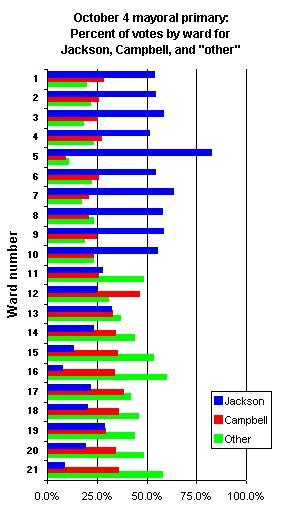 Note that Jackson got more than 50% of the primary votes in every ward from 1 through 10, the largely Black wards which collectively cast half of all votes citywide. Campbell led Jackson in Wards 12 through 21 (except for a virtual tie in Ward 19), but she failed to pull a majority anywhere and ran behind "Other" in every West Side ward (13-21) as well as Collinwood (11).
In other words, Jackson's main base of support looks solid, while the rest of the city looks very much up for grabs. This is very daunting arithmetic for the Mayor, no matter how the turnout grows in November.
(The percentages in the chart are calculated from ward vote totals reported in the Board of Elections's "Unofficial Canvass Report" on Tuesday's election, posted yesterday.)
Even so, the picture below can't be encouraging for the Campbell campaign:
Note that Jackson got more than 50% of the primary votes in every ward from 1 through 10, the largely Black wards which collectively cast half of all votes citywide. Campbell led Jackson in Wards 12 through 21 (except for a virtual tie in Ward 19), but she failed to pull a majority anywhere and ran behind "Other" in every West Side ward (13-21) as well as Collinwood (11).In other words, Jackson's main base of support looks solid, while the rest of the city looks very much up for grabs. This is very daunting arithmetic for the Mayor, no matter how the turnout grows in November.
(The percentages in the chart are calculated from ward vote totals reported in the Board of Elections's "Unofficial Canvass Report" on Tuesday's election, posted yesterday.)
10.05.2005
PHILADELPHIA: CITYWIDE WIRELESS BROADBAND BY THIS TIME NEXT YEAR
From yesterday's Philadelphia Business Journal:
(Thanks to Phil Shapiro for the heads-up, via the CTCNet members email list).
From yesterday's Philadelphia Business Journal:
Internet service provider Earthlink was chosen by Wireless Philadelphia Monday to deploy a high-speed wireless network to serve the city's 135 square miles.More at Wireless Philadelphia's website.
Under the terms of the proposal no city or taxpayer dollars will be used. Earthlink, which is partnering with Motorola (NYSE: MOT - News), Canopy and Tropos Networks, will cover all of the costs of constructing, deploying and maintaining the network, which will be fully operational by the fourth quarter of next year.
Earthlink will rent space on the network to multiple Internet service providers and community organizations, such as colleges, who in turn will sell high-speed Internet access to city residents for about $20 per month and $10 per month for lower-income households, Dianah L. Neff, chief information officer for Philadelphia, said. Occasional access for business travelers and visitors to the city will also be available for a fee and free access will be available in some parks and public spaces.
Wireless Philadelphia, a city-created nonprofit organization, will receive a portion of the fees collected by Earthlink, which it will use to support programs addressing the digital divide and economic development, Neff said.
(Thanks to Phil Shapiro for the heads-up, via the CTCNet members email list).
10.04.2005
TURNOUT
I voted at 2 p.m. at precinct 15F, at Denison Elementary in the Archwood-Denison area. There are 1,047 registered voters in 15F. I was voter number 54.
The election judges said the trickle of voters looked just like the school levy in August. Total ballots cast in that election: 87.
I think they may be exaggerating a little, but it still looked awfully slow for a beautiful day, with hotly contested primary races for both Mayor and City Council.
Update: Apparently this is the story all over the city.
Update: My 8:30 instant analysis, with Jackson holding 50% of the 5400 votes counted so far... low turnout favors the guy with a turnout campaign. That's Jackson. He'll be the big fish in tonight's little turnout pond.
Final comment: My precinct's election judges weren't that far off. The citywide turnout today was only about 53,000 -- much closer to the 43,000 who voted in August's levy election than to the nearly 85,000 who showed up for the mayoral primary four years ago. In my ward, Ward 15, only 3,200 people cast ballots in the very tight, very visible Council primary... barely 500 more than turned out for the "invisible" school levy.
Both Jackson and Campbell need to think long and hard about why this campaign is connecting with so few Cleveland citizens.
(Speaking of that tight Ward 15 Council race, it had one of the few surprising results of the evening. Former Old Brooklyn CDC director Brian Cummins, running his first race with no significant outside allies or endorsements, edged out the very campaign-savvy (and labor-endorsed) Rick Nagin for second place behind incumbent Emily Lipovan Holan. The totals: Emily, 1,060; Brian, 814; Rick, 693; four other candidates combined, 670. This'll be one to watch in November.)
I voted at 2 p.m. at precinct 15F, at Denison Elementary in the Archwood-Denison area. There are 1,047 registered voters in 15F. I was voter number 54.
The election judges said the trickle of voters looked just like the school levy in August. Total ballots cast in that election: 87.
I think they may be exaggerating a little, but it still looked awfully slow for a beautiful day, with hotly contested primary races for both Mayor and City Council.
Update: Apparently this is the story all over the city.
Update: My 8:30 instant analysis, with Jackson holding 50% of the 5400 votes counted so far... low turnout favors the guy with a turnout campaign. That's Jackson. He'll be the big fish in tonight's little turnout pond.
Final comment: My precinct's election judges weren't that far off. The citywide turnout today was only about 53,000 -- much closer to the 43,000 who voted in August's levy election than to the nearly 85,000 who showed up for the mayoral primary four years ago. In my ward, Ward 15, only 3,200 people cast ballots in the very tight, very visible Council primary... barely 500 more than turned out for the "invisible" school levy.
Both Jackson and Campbell need to think long and hard about why this campaign is connecting with so few Cleveland citizens.
(Speaking of that tight Ward 15 Council race, it had one of the few surprising results of the evening. Former Old Brooklyn CDC director Brian Cummins, running his first race with no significant outside allies or endorsements, edged out the very campaign-savvy (and labor-endorsed) Rick Nagin for second place behind incumbent Emily Lipovan Holan. The totals: Emily, 1,060; Brian, 814; Rick, 693; four other candidates combined, 670. This'll be one to watch in November.)
BROWN BACK IN DEWINE RACE? More on this from Daily Kos yesterday. Kos quotes the National Journal's "Hotline":
So there might be a Democratic primary in 2006. So much the better. All the candidates can use as much early statewide exposure as possible, especially Hackett, Strickland and Coleman. The bigger the suspense, the bigger the headlines in May and June.
Run, Sherrod, run!
Rep. Sherrod Brown (D-13) spokesperson Joanna Kuebler, on Brown's previous statement he would not run: "His statement has not changed at this time. However, Congressman Brown continues to be asked by state and national supporters to run for the United States Senate in Ohio. Personal and professional obligations have changed since his initial decision. He is consulting with supporters and his family about a possible run" (Hotline reporting, 10/3).Kos thinks Sherrod's off-again-on-again action is "weird". Nuthin weird about it. As democracy guy points out, polling that shows Paul Hackett leading Dewine, while undeniably a tribute to Hackett's rising star, basically means Dewine is in big, big trouble against any opponent. Brown can read polls, too. Plus Kuebler's assertion that Sherrod "continues to be asked by state and national supporters to run for the United States Senate" is not the usual hot air in this case; a lot of Ohio Democrats have been just as antsy as me about his choice to sit this one out.
So there might be a Democratic primary in 2006. So much the better. All the candidates can use as much early statewide exposure as possible, especially Hackett, Strickland and Coleman. The bigger the suspense, the bigger the headlines in May and June.
Run, Sherrod, run!
10.03.2005
SAY ANYTHING: Ward 21 Councilman Michael Dolan at the Steelyard Commons groundbreaking, as quoted by Ohio News Network:
Councilman Michael Dolan believes Wal-Mart will be good for the economy, give customers more choices and maybe cater to unions.Dolan also expressed confidence that we can convince Microsoft to adopt open-source licensing, the People's Republic of China to recognize an independent Taiwan, and al Qaeda to embrace Satyagraha.
"This is a union-built project. I have every confidence if we put our minds, hearts and souls into sending the right people to work here, we'll be able to convince Wal-Mart they ought to be a union shop," says Dolan.
NEW WKYC POLL: STILL OVERSAMPLING COLLEGE GRADUATES, STILL IGNORING PATMON
WKYC has just posted a last-minute repeat of its SurveyUSA poll on the Mayor's race. It shows Jackson at 35% (up 5%), Campbell 26% (up 3%), Draper and Triozzi effectively tied at 10-11%, Lynch at 8%.
The new poll's crosstabs still show a "likely voter" sample that's way better educated than Cleveland's voting-age population.
And it still fails to ask voters about Bill Patmon by name.
WKYC has just posted a last-minute repeat of its SurveyUSA poll on the Mayor's race. It shows Jackson at 35% (up 5%), Campbell 26% (up 3%), Draper and Triozzi effectively tied at 10-11%, Lynch at 8%.
The new poll's crosstabs still show a "likely voter" sample that's way better educated than Cleveland's voting-age population.
And it still fails to ask voters about Bill Patmon by name.
SHERROD BACK IN THE SENATE RACE?
Via Josh Marshall via democracy guy, a new Washington Post blog says Congressman Sherrod Brown may be reconsidering his decision not to run for Mike Dewine's Senate seat.
If true, it's very, very good news.
Via Josh Marshall via democracy guy, a new Washington Post blog says Congressman Sherrod Brown may be reconsidering his decision not to run for Mike Dewine's Senate seat.
If true, it's very, very good news.
MY CANDIDATE'S CAMPAIGN PROMISES: Well, gang, primary voting starts in twenty-three hours and I still don't know which mayoral candidate I'll vote for.
Mostly this is because no candidate has made any of the campaign promises that would matter to me.
No candidate has said: "It's none of my business where people shop, but everyone knows Wal-Mart maintains its low prices by systematically scoffing at Federal labor law, knowing that the law won't be enforced by the Feds. As Mayor I will not tolerate this kind of behavior in our community by Wal-Mart or any other company. I'll instruct the Law Department to evaluate all complaints of unfair labor practice by Wal-Mart and other non-union retailers in the city, and look for ways to support those that are legitimate. And I'll push City Council to amend the city's Fair Employment Wage Law to include major retailers like Wal-Mart, before we consider any more big box retail developments."
No candidate has said: "This City signed up more than 30,000 new customers for Cleveland Public Power in the '90s by promising they'd pay lower electric rates compared to CEI. We are breaking that promise every month. As Mayor, I intend to make good on it. I will reduce Public Power's residential rates by at least 20% in the next four years."
No candidate has said: "The most important economic development issue for Cleveland is the education level of our work force. For fifteen years we've been measuring our development success by the number of vacant lots we've turned into new homes. It's time to start measuring our progress by the number of our working-age residents who go to college. If elected, I'll make sending Cleveland to college my top economic development priority... higher on the list than a new convention center." (Frank Jackson came closest by calling for two years of free college for city residents in a PD op-ed back in May, but has not repeated this since.)
No candidate has said: "Twenty-first century technology is just as important for neighborhood development as it is for downtown and regional development. As Mayor, I'll put low-cost broadband Internet access high on my citywide neighborhood development agenda."
Those are a few of the promises my candidate for Mayor would be making... if my candidate was running.
Nevertheless, I'll see you at the polls.
Mostly this is because no candidate has made any of the campaign promises that would matter to me.
No candidate has said: "It's none of my business where people shop, but everyone knows Wal-Mart maintains its low prices by systematically scoffing at Federal labor law, knowing that the law won't be enforced by the Feds. As Mayor I will not tolerate this kind of behavior in our community by Wal-Mart or any other company. I'll instruct the Law Department to evaluate all complaints of unfair labor practice by Wal-Mart and other non-union retailers in the city, and look for ways to support those that are legitimate. And I'll push City Council to amend the city's Fair Employment Wage Law to include major retailers like Wal-Mart, before we consider any more big box retail developments."
No candidate has said: "This City signed up more than 30,000 new customers for Cleveland Public Power in the '90s by promising they'd pay lower electric rates compared to CEI. We are breaking that promise every month. As Mayor, I intend to make good on it. I will reduce Public Power's residential rates by at least 20% in the next four years."
No candidate has said: "The most important economic development issue for Cleveland is the education level of our work force. For fifteen years we've been measuring our development success by the number of vacant lots we've turned into new homes. It's time to start measuring our progress by the number of our working-age residents who go to college. If elected, I'll make sending Cleveland to college my top economic development priority... higher on the list than a new convention center." (Frank Jackson came closest by calling for two years of free college for city residents in a PD op-ed back in May, but has not repeated this since.)
No candidate has said: "Twenty-first century technology is just as important for neighborhood development as it is for downtown and regional development. As Mayor, I'll put low-cost broadband Internet access high on my citywide neighborhood development agenda."
Those are a few of the promises my candidate for Mayor would be making... if my candidate was running.
Nevertheless, I'll see you at the polls.
Subscribe to:
Posts (Atom)